Business Success with Enterprise Integration Services and Strategy


In today’s digital age, businesses rely on various software solutions to manage their operations, improve productivity, and enhance customer experiences. The efficiency of these tools can be significantly hampered if they operate in isolation.
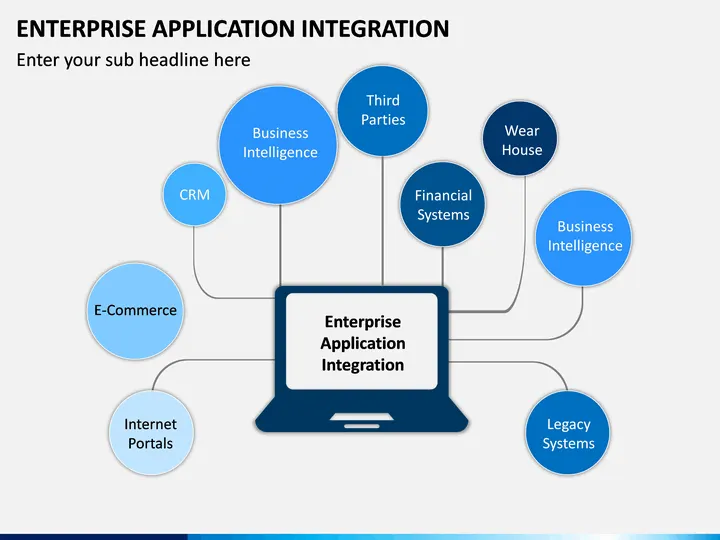
Enterprise integration services (EIS) facilitate smooth communication and data transfer among various software systems within a company. They connect on-premises and cloud-based applications. This enables them to function as a cohesive unit. By bridging gaps between platforms, these services-
- Automate workflows
- Reduce redundancy
- Maintain consistency across business processes.
Why Enterprise Integration Is Essential
Streamlined Operations: Manual data entry and repetitive tasks are not needed with correct integration strategies. They reduce the risk of human error and free up valuable time for employees to focus on more strategic activities.
Enhanced Data Accuracy: By connecting different systems, integration services ensure that data is consistently updated and accurate across all platforms. This timely and dependable information greatly aids in decision-making.
Accurate data flow between systems helps businesses maintain high data integrity. This is crucial for operations like financial reporting and customer service.
Improved Customer Experience: Seamless data sharing across applications allows businesses to provide personalized and timely responses. This boosts customer satisfaction and loyalty. When customer data is accessible across various systems, support teams can quickly address issues and deliver customized solutions.
Scalability: Integration services offer the flexibility to add new applications and systems without disrupting existing workflows. This scalability ensures that businesses can adapt to changing demands and integrate new technologies smoothly.
Key Components of EIS
Get ThinkAI Corp’s stories in your inbox
Join Medium for free to get updates from this writer.
Integration Platforms: These platforms provide a centralized solution for integrating multiple applications. They offer pre-built connectors, APIs, and tools for custom integrations. An integration platform can serve as the backbone of a company’s digital infrastructure.
APIs (Application Programming Interfaces) enable various software systems to interact by establishing rules and protocols. They allow real-time data exchange with minimal effort. APIs are crucial for creating a connected ecosystem where data flows freely and securely.
Middleware: Middleware acts as a bridge between applications. It handles data formatting, compatibility, and routing between systems. It ensures that different applications can work together by handling the complexities of data exchange and integration.
ETL (Extract, Transform, Load) tools gather data from different sources, convert it into an appropriate format, and then import it into a target system. ETL Tools are essential for data migration, integration, and warehousing. Consolidation of data from multiple sources into a single repository helps in analysis and decision-making.
How Do Apps Help in Integrating Enterprise Services?
The rise of various applications has transformed business operations. However, connecting these diverse apps to create a unified ecosystem is challenging. Enterprise integration services address this challenge by providing the tools and frameworks needed to integrate different applications seamlessly.
Pre-Built Connectors: Integration platforms offer pre-built connectors for popular applications. These connectors simplify the integration process, enabling businesses to connect their apps quickly and efficiently. For example, an e-commerce business might use pre-built connectors to integrate its online store with payment gateways and shipping providers.
Custom integrations: Although pre-built connectors are useful, they might not address all specific business needs. Integration services provide tools for developing custom integrations tailored to particular needs, ensuring that even niche applications can be seamlessly integrated.
Workflow Automation: Integration services enable the automation of complex workflows involving multiple applications. For instance, when a new customer signs up, their details can be automatically added to the CRM, an email welcome sequence can be triggered, and a task can be created in the project management tool — all without manual intervention.
Data Synchronization: Ensuring that data is synchronized across all applications is crucial for maintaining accuracy and consistency. Integration services continuously monitor data changes and synchronize updates in real-time, ensuring that all systems reflect the most current information.
Choosing the appropriate enterprise integration strategy depends on various factors, such as the complexity of the IT environment, the number of applications to integrate, budget limitations, and specific business needs.
In Conclusion
AI integration services assist clients in embedding artificial intelligence, automation, and machine learning into their operations. Examples include AI-powered chatbots, analytics systems, and automated workflows.
Increased efficiency and productivity, improved decision-making through data analysis, enhanced customer experience, and cost savings are a few of the benefits AI offers to businesses. Furthermore, by automating workflows, AI allows companies to achieve more without scaling staff, and supports human operators by handling tedious tasks. AI tools like chatbots enhance customer service, ensuring access to information even when staff are unavailable.
Think AI offers a comprehensive solution for businesses that want to make the best use of enterprise integration services. These services include secure data transfer within and outside your firewall, connectors for public cloud applications, fast deployment of new integrations, and better integration economies to support endpoint growth. Ready to take your business to the next level? Visit us here!